The Runtime AI Control layer.
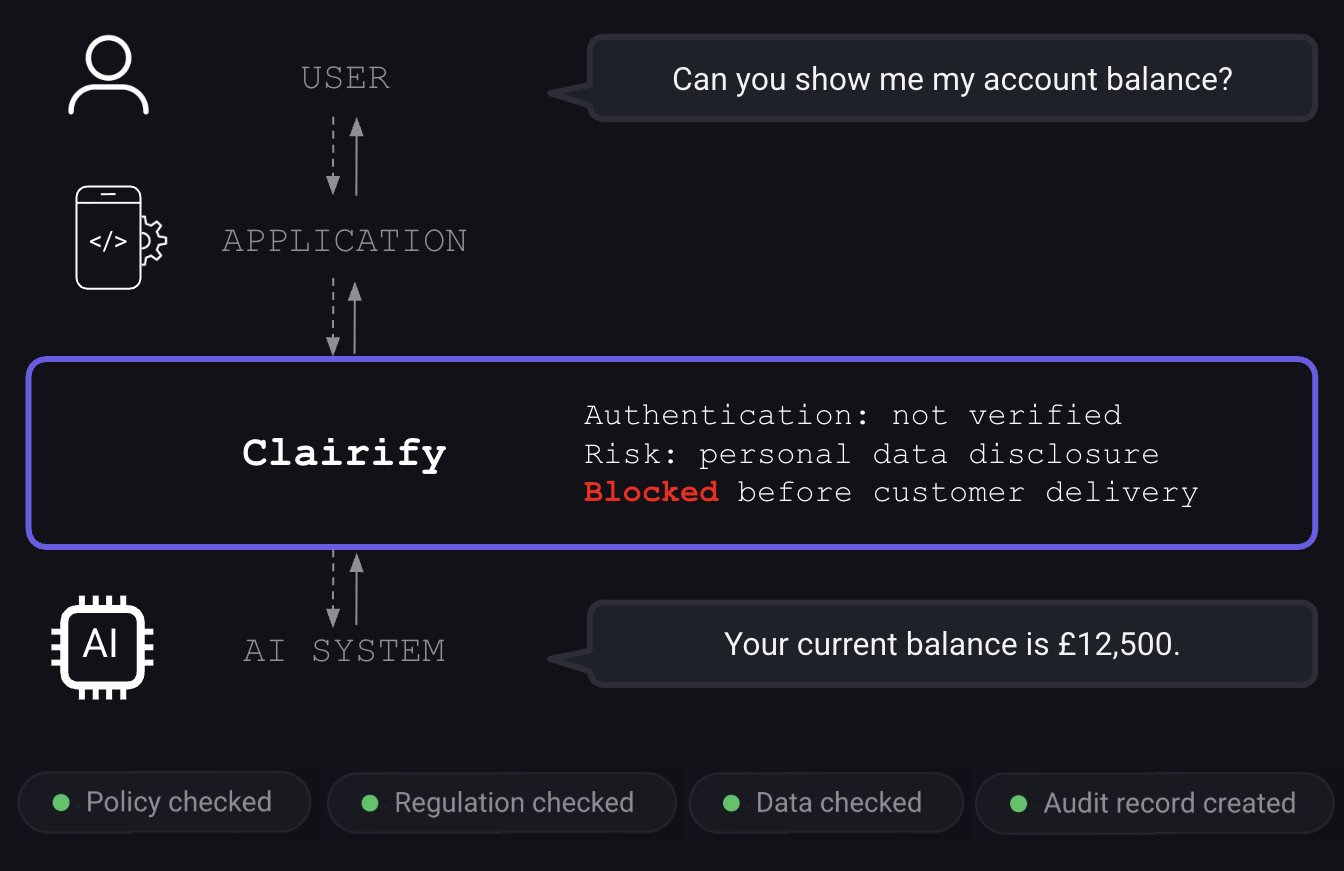
Clairify enforces policies and regulations on AI at runtime. It sits between the AI and the end user, checking every AI output before it reaches a customer and blocking or escalating anything that violates a rule. The rules are deterministic, so every decision is explainable and regulator-ready.
How It Works
Runtime control in the flow of delivery.
A user sends a request.
Clairify gets a copy of the request.
The AI drafts a response or proposes an action.
Clairify checks the draft output against applicable risks.
If a risk is found, Clairify blocks, escalates, or alerts.
The final approved output is sent to the user.
The full assessment is logged for regulatory evidence.
This describes Runtime Enforcement. See how Clairify deploys.
Risk Rules
Deterministic rules grounded in policy and regulation.
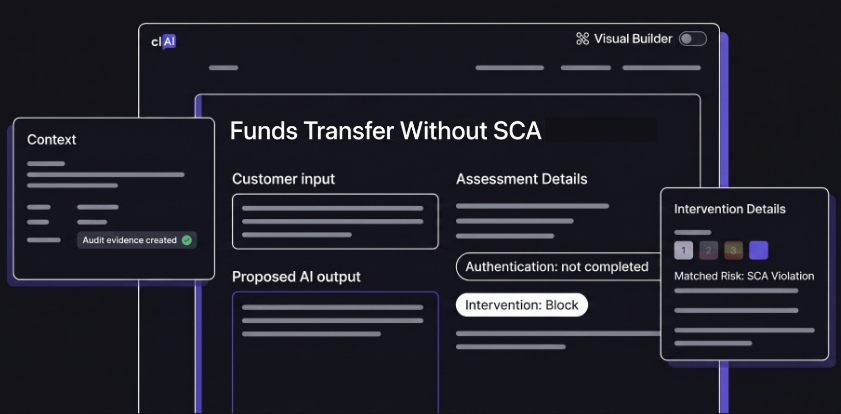
The Risk Rule Repository defines what Clairify looks for. Rules are derived from policies and regulations. Validation draws on authoritative data sources to assess each output at runtime.
Clairify's pre-built domain model covers all major financial services and insurance regulations. Customers extend these with their internal policies and controls.
Validation draws on
- Customer data
- Product and pricing data
- Real-time system data
- Human reviewer input
- Policies and regulations
Regulatory Coverage
Pre-built coverage across UK, US, and international frameworks.
Clairify's pre-built risk model is grounded in core financial services obligations. Customers can extend it with their own internal policies and jurisdiction-specific obligations.
20
🇬🇧 UK frameworks
17
🇺🇸 US frameworks
2
🌍 International frameworks
Runtime Interventions
A runtime engine that assesses every output.
The Runtime Engine sits between the AI and the end user, checking every AI output before it reaches a customer and blocking or escalating anything that violates a rule.
It collects the variables needed to evaluate risks, using the most authoritative source available. As much as possible, variables come from internal systems of record.
Intervention logic is deterministic. That means it can create regulator-ready evidence for every assessment, while rules continue to apply as new AI applications get introduced and existing AI models get updated.
Intervention Types
When Clairify identifies a risk, the intervention is defined by the rule.
Block
Unsafe or non-compliant outputs are stopped before delivery.
Human approval
Outputs requiring review are routed with the risk summary, evidence, and context.
Alert
Lower-risk events can be logged and flagged for later review without interrupting the user journey.
Allow
Outputs that pass the applicable controls continue to the end user, with the assessment still recorded.
Assisted Review
Human judgement with pre-assembled context.
Reviewing AI outputs is time-consuming. Fluent, confident responses can make fabricated facts, misapplied policy, or other subtle errors hard to spot, an effect sometimes referred to as 'automation bias'.
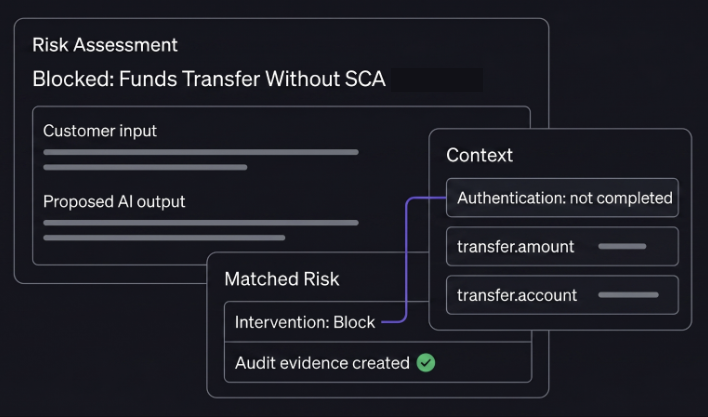
Clairify routes outputs that need judgement to reviewers with the information they need to decide: the AI output, the relevant risk summary, customer context, evidence, and policy basis.
This makes review faster and more consistent and helps reduce automation bias.
Reviewers can approve, reject, reassign, or escalate the output, with the full decision recorded in the audit log.
Operating Modes
The right level of control, applied automatically.
Clairify runs in three ways depending on the risk severity, whether human judgment is required and whether the underlying model is in test or production.
Diagnostic
Clairify logs and analyses every output without interrupting the user experience. It generates regulator-ready audit logs and surfaces risk patterns across your AI systems.
Applied when
Low severity risks and AI models in test or staging.
Assisted Review
Clairify surfaces risk summaries, evidence, and customer context to support human reviewers. It speeds up sign-off and reduces automation bias where confident AI failures go unnoticed.
Applied when
An AI output requires human review before it is delivered.
Runtime Enforcement
Clairify enforces controls in real time before outputs reach the user. It can block, escalate, alert, or allow responses based on the risk rules defined for each application.
Applied when
High severity risks where automated enforcement is warranted.
Deployment
Designed for regulated environments.
Infrastructure
Runs in your environment.
Clairify deploys on-premise or in your private cloud. Sensitive customer, policy, and workflow data stays inside your environment.
Variable extraction uses open-source, self-hosted models — no customer data leaves your environment and no third-party token costs per output checked.
deployment: on-premise | private-cloud
variable-extraction: self-hosted
data-egress: none
token-costs: none
model-updates: decoupled
Security
Built for enterprise security expectations.
SOC 2
Compliant controls for security, availability, and confidentiality.
ISO 27001
Information security management to enterprise standard.
Data residency
All data stays inside your environment. Nothing leaves.
Connectors
Connects to your stack.
Ready to control AI outputs at runtime?
If you are deploying AI in customer-facing or high-risk workflows, Clairify can help you check outputs before delivery and create regulator-ready evidence for every decision.
Book a call